Thursday, March 8, 2012

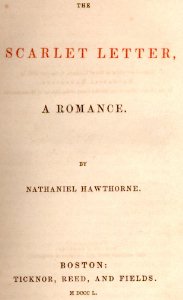
The Scarlet Letter


by Nathaniel Hawthorne

I only read 55% of this book on my Kindle and did not enjoy it very much. The first part (before the author went into the story) was decent but after that it just fell on the wayside. Several reasons why.

First I did not like the story. It is about a woman who had a child out of wedlock and has to bear the shame of having a bastard child. My gripe is not with this concept actually. It could have been a very emotional and touching journey. However, I did not feel an inkling of feeling for the main character Hester Prynne. Furthermore, through the author's prose, it seems the place of woman at the time was in the kitchen. This is shown in the early sections where he says the utility of a woman is cooking and cleaning (or something to that effect, I cannot remember the exact words). Perhaps this was an ironic statement, though i feel not. Perhaps this story does not carry much weight in the current society, life has advanced so much from 1850 after all. That said, I still feel there are books out there that describe their respective period with much more emotion and impact, Like To Kill A Mockingbird. Or perhaps 1850's English is so hard to read that I just cannot fully appreciate the beauty in the words. I felt the prose lacked elegance and were very poorly constructed at times.

It is surprising I would have such a negative of such a popular and classical piece of literature. I guess it really is subjective people's taste in book. I really cannot say I enjoy this book no matter how much I tried to force myself to.

Thursday, February 16, 2012

Free Culture

by Lawrence Lessig

This book is about American copyright law and how it affects free culture. This of course covers mostly the internet and how its use has affected the current mode of distribution for music, books, art, movies and so on. Obviously piracy is a big issue right now. This book elucidates the particular issues on this matter not in terms of the regular talking points of the media such as 'piracy is killing creativity' or 'piracy will bankrupt the industry'. It goes into a much more deeper level than this and explains the wider implication and puts into context what this advent of digital distribution has meant, what it means now and what it will mean in the future. Overall, it is a very good and insightful book.

I actually finished this book several days ago, took me 2 months or so because it was something that I put down and stopped reading, but continued reading again after some time. I put it down not because it wasn't good, but I was reading some other things at the same time too.

In-line with the values of this book, you can download the book from this link.


Monday, January 9, 2012

Steve Jobs

by Walter Isaacson

This was a book that I really wanted to read and just completed it during my trip to Beijing and Harbin, China. It is the autobiography on Steve Jobs, the creator of Apple and Pixar Studios. It is a wonderful book on the creative genius and his process, his temperament, relationships and life. Before I never understood all the hype about Apple products but after reading this book I have a better appreciation for the philosophy behind Apple products and where they sit within the technosphere. Steve Jobs is a truly enigmatic and unique individual and one could just wonder what wonderful things he would have come up with if he was still alive. Isaacson does Jobs justice with a comprehensive and detailed account of his life's achievements, events and tribulations. A wonderful read; an inspiring and insightful book.